The sisterhood of the travelling prints
Finding home amongst printed pages.
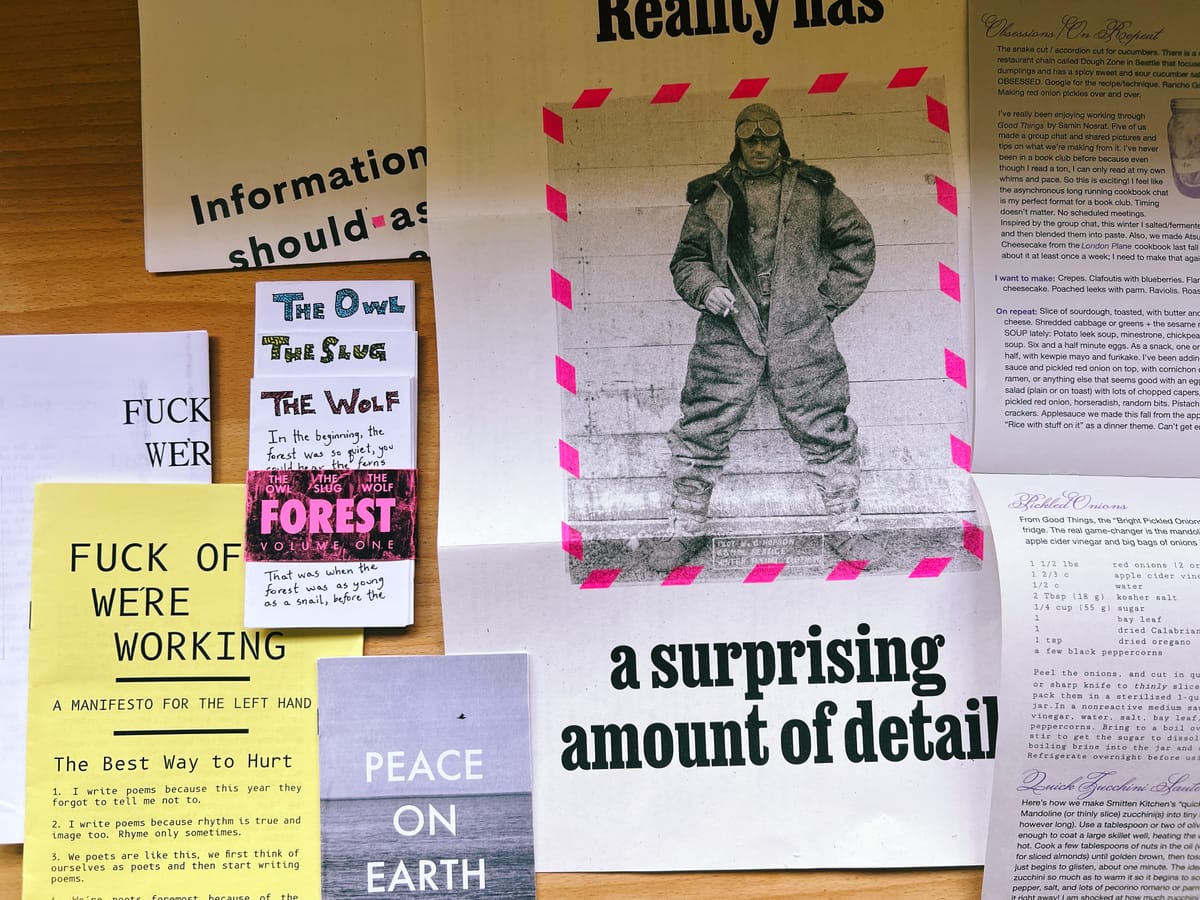
As we were leaving our home in California back in January, I checked the mailbox one last time. I'm so glad I did! In that morning's postal delivery, mail from my friend (and a fellow writer and artist publisher) Jasper Nighthawk had arrived containing various wonderful printed things including his family's Christmas zine, two iterations of a manifesto and a whimsical set of micro-zines – Forest Vol. 1 – published by his aptly named press, Enchant Books. I stashed these back in the envelope so they wouldn't get lost in the long journey to Cape Town.
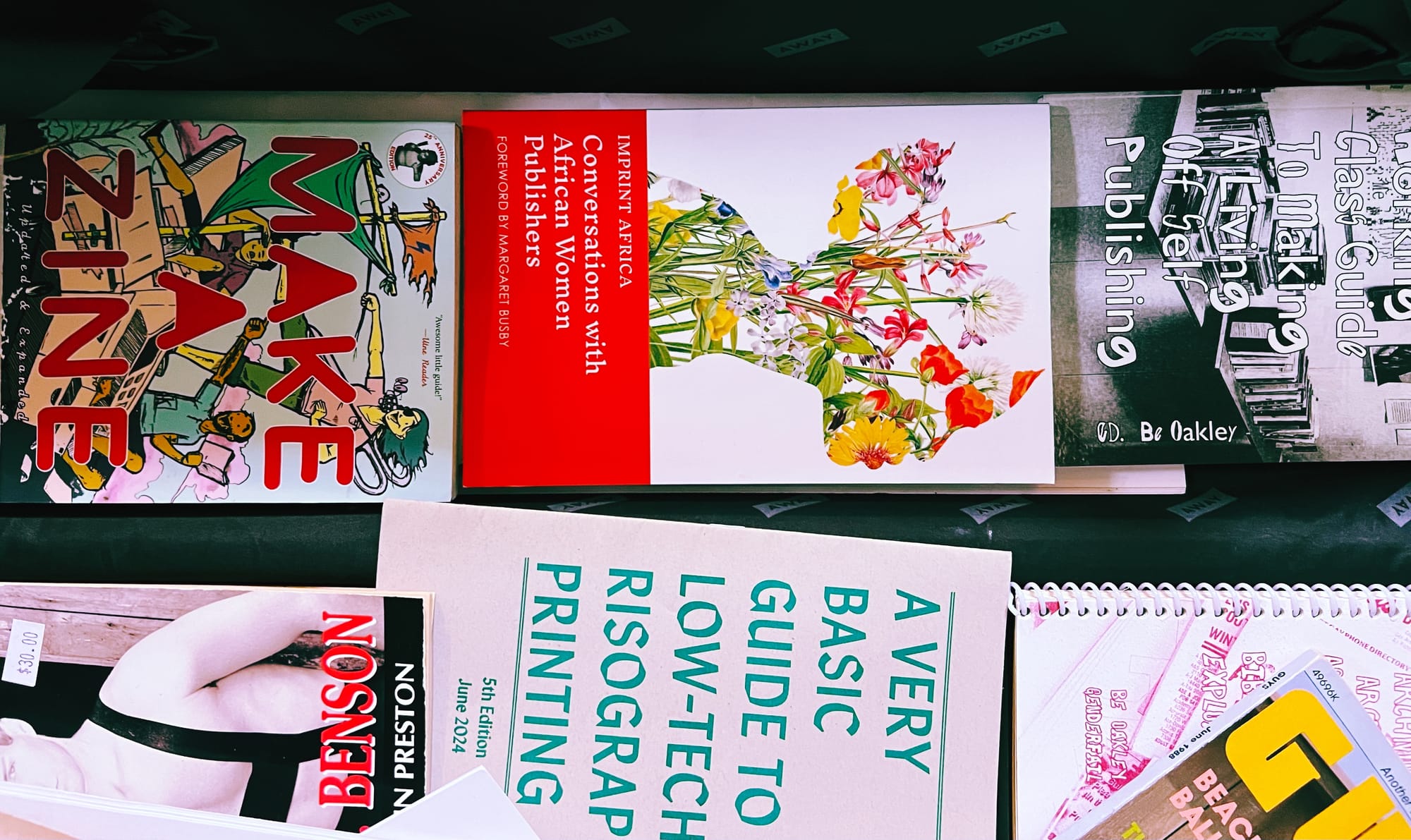
More recently, my mother-in-law has played postmistress on her visit to South Africa, bringing with her a number of publications I'd arranged to be mailed to her (she lives in Philadelphia). This included a wondrous food/kitchen-themed riso-printed newsletter from ANEMONE's Amelia Greenhall, two Robin Sloan zines, and the new issue of gay poetry journal & Change. All these join the somewhat sizeable haul of printed matter (books, zines, pamphlets, posters) I'd brought with me from California to Cape Town. In the months to come, I hope they'll provide ample inspiration, insight, entertainment. But, perhaps most of all, they're like a paper patchwork security blanket. Printed pages as a form of solace, succour, support. As an extension of myself, perhaps – and reminders (satisfyingly tangible and tactile, no less) of friends, collaborators, role-models and inspirations. A patchwork blanket helping to make this strange time and place – at once familiar and rather changed – home. In a Dispatch in 2022, I declared that "home is where the art is" but in reality I'm finding home right now in print – in the just-unpacked printed publications I've placed on the bookshelf in my childhood bedroom; in the risograph art print from Fresno's Laguna Collective recently framed by a Cape Town framer; and in the still-to-be-realised print projects of my own.
- [The fine print] I bought Robin Sloan's zines from his shop. You can get Jasper Nighthawk's Forest Vol. 1 from Enchant Books. The ANEMONE risograph-printed publications made by Amelia and Adam Greenhall can be purchased from Riso Bookstore. Incidentally, Jasper, Amelia and Robin all have WONDERFUL email newsletters, too – each are amongst my absolute must-read faves. I highly recommend subscribing.
Somewhere between swimming weather and sweater weather
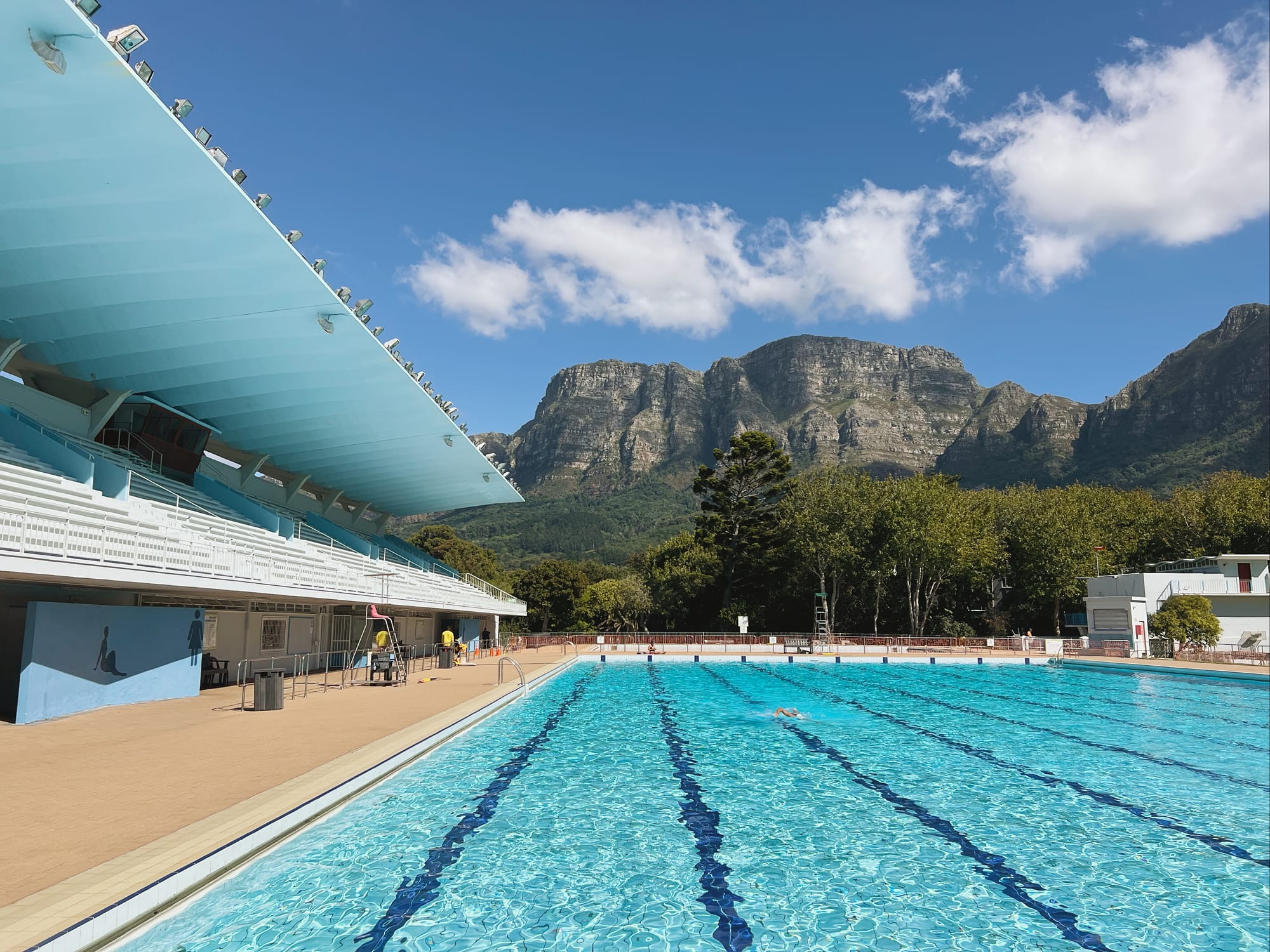
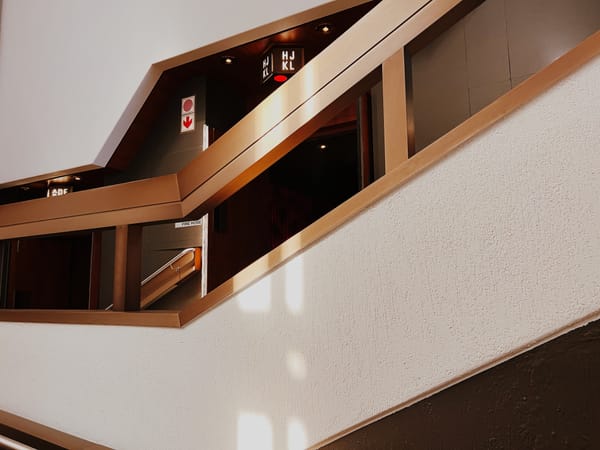
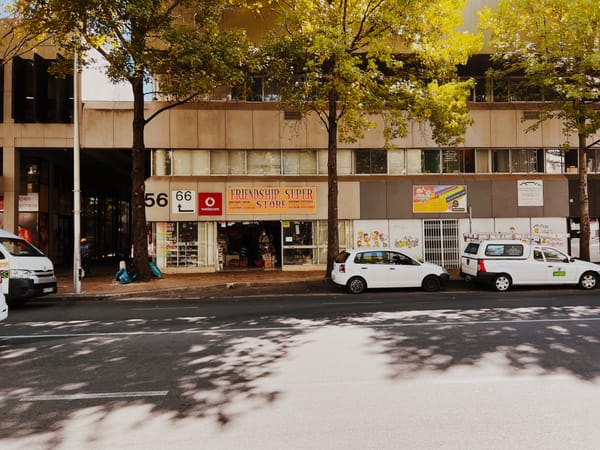
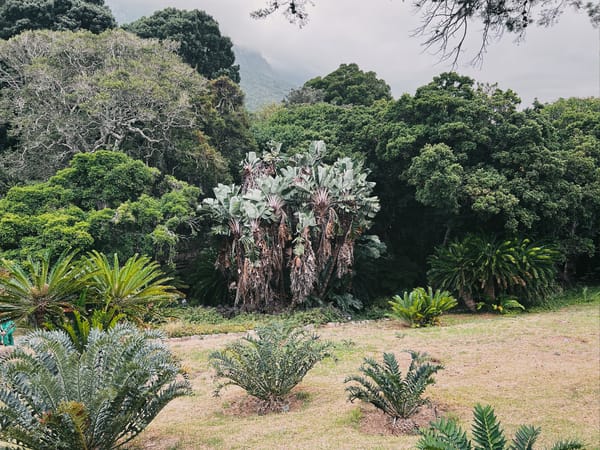
Cape Town's wind-scorched summer has softened into gentle, temperamental autumn. I've reached the halfway point in my first semester at university (and remain enthralled by the law faculty's Kramer Building, which I visit weekly for my mind-altering Law and Society in Africa seminar). Off campus, there has been swimming at the public pool, a stroll in Kirstenbosch, soaking up the city, watching the ballet and browsing a little print fair. Mom had spinal surgery. Progress on my novel's (hopefully!) final chapter is painstakingly slow and haphazard, but I'm persevering.
The residues > treasure
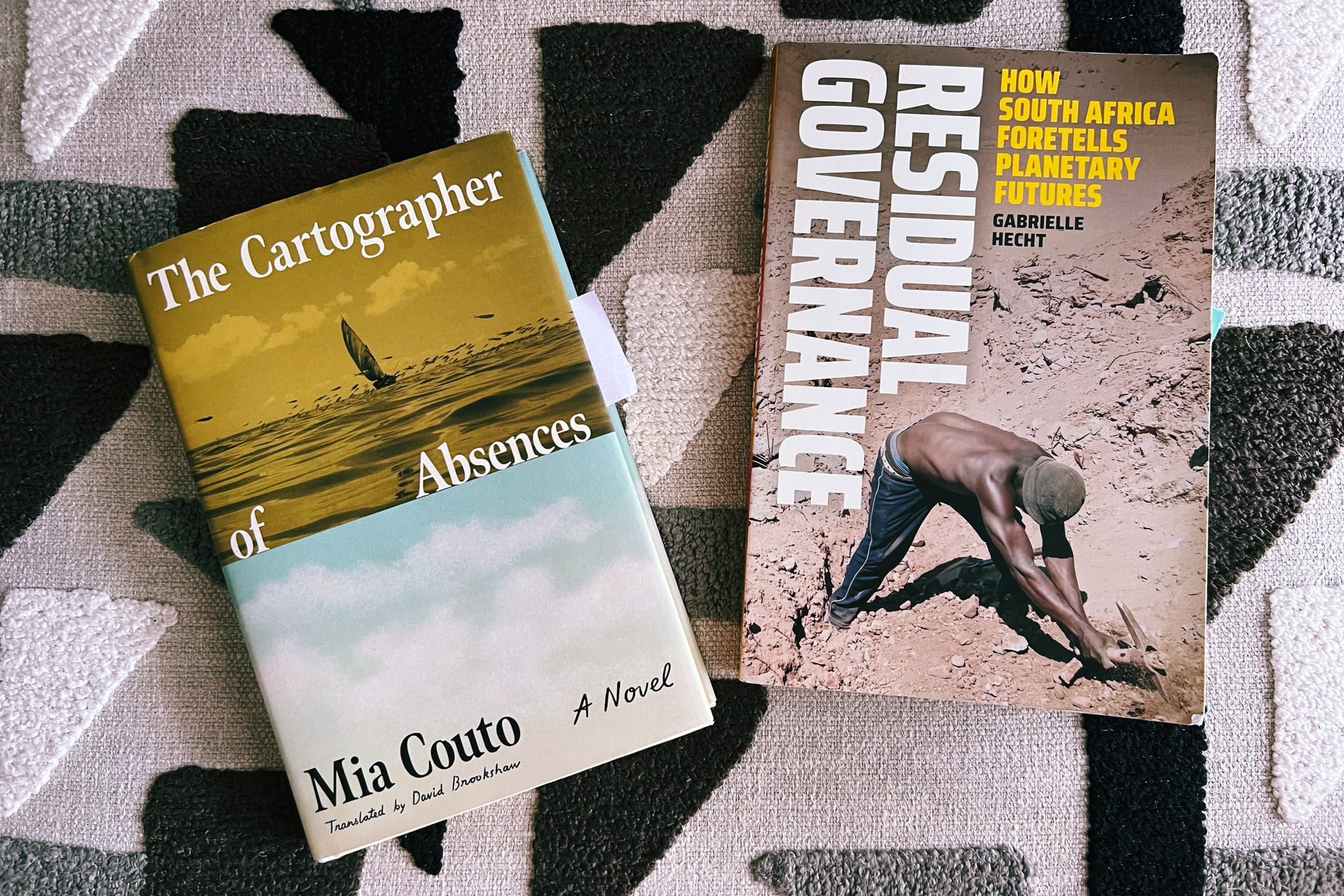
Currently reading Mia Couto's latest novel, an English translation from the Portuguese. Captivating, haunting, melancholy, gorgeous. (And, thankfully, it isn't magical realism – his typical genre – which I'm somewhat allergic to.) Strangely/sadly The Cartographer of Absences is not published in print in South Africa, despite it being written and set in neighbouring Mozambique (the copy I have here I bought in the US). That is, of course, the physical/print's chief drawback: to read the thing, the thing has to be where you can reach it.
Gabrielle Hecht's Residual Governance, a study of how mine waste in South Africa's Gauteng province is dealt with (or not dealt with) – was an eye-opening, unsettling, vital read. Will never be able to look at Joburg's mine dumps in the same way. Residual Governance grapples with the "governance of residues":
Most straightforwardly, this involves managing discarded materials. Mining, goes the industry's inside joke, is above all a waste management project. Profitable minerals typically occupy a minute proportion of their host rock, a ratio known as ore grade. The highest gold grade ever recorded in South Africa was 22 grams per ton of rock. That was in 1905. Since the late 1970s, grades haven't exceeded 10 grams per ton. Concretely, that means a typical 14-karat gold chain contributes one ton of discarded rock (degraded earth) to the Rand's tailings piles – not counting the waste produced by mining the copper, palladium, and other metals that compose 40 percent of the 14-karat alloy. The residues, in other words, constitute far more material than the treasure. South Africa has recorded 6,150 abandoned mines, most of them on the Rand. Their residues continue to morph, spread, and poison. Managing these residues occupies an ever-increasing proportion of financial, administrative, and expert resources.
But Hecht also contemplates "governance as a residual activity, typically tacking between minimalism and incrementalism, using simplification, ignorance, and delay as core tactics. In a world that fetishizes commodities, the price of stuff rarely includes the costs incurred by its waste streams".
- Residual Governance is an Open Access publication (so you can read it for free – if you can stomach staring at a screen for that long).
Screen-time < Real Life
An essay in thought-fragments reflecting on analogue and digital, and the richness of the physical.
The digital often fragments and drains attention; the analogue often sustains and nourishes it.
The digital is quicksand, a two-dimensional waterfall, a bombardment, flat and slippery, fleeting yet relentless. The analogue has heft, texture... to appreciate it fully involves a greater spectrum of sensory inputs (not just sight and sound, but smell and touch, too).
Robin Sloan puts it more eloquently than I. In one of his aforementioned zines (Reality has a surprising amount of detail) he writes:
The number of virtual worlds, of competing infoscapes, of mad digital dioramas, is infinite.
The number of physical worlds is one.
This is it, here in your hands. Ground-floor reality. In the haze of endless options, I find it bracing to recognize that this one thing is mandatory. You go to sleep in it; you wake up into it. You share it with all the other living creatures of Earth. Assaulted by digital noise, it is unmoved and unmovable. The physical world has nothing to prove.
A simple thing, but so precious in this century: solid ground.
In that stirring risograph-printed broadside, Robin urges a "return to the physical world, with renewed appreciation for all its powers and features". He waxes lyrical about the United States Postal Service, about the wonders of sending physical, printed mail at very affordable rates, across the country – which has been possible since, pretty much, America's founding. I am in exuberant agreement: a functioning, reliable, affordable postal service is a wonderful, wonderful thing (and I grieve that South Africa's Post Office is largely a dysfunctional, erratically-delivering mess). One of the greatest joys of publishing my novel, The President, incidentally, was the physicality of it; of preparing to send it, taking it to my local post office to be mailed etc. It was a thing! Something I could hold in my hands. A thing I could hand over, send. A thing received by readers far, far away.
Digital = fast food... addictive, but of little harm if indulged in occasionally. If a means to an end (to enrich, to accent real life) then okay, but if it becomes the end in itself, something that displaces the physical, then it impoverishes, numbs and blinds us; we become digital zombies – vacant, absent, oblivious.
Analogue = eating fruit you've picked from a tree... involves labour, requires (in the immediate moment) more effort, it's slower. Yet ultimately more rewarding, energising and nutritious than screen-time.
Amelia Greenhall writes beautifully about the boundaries she's set around her use of electronics. I guess one might call this kind of boundary-setting "digital hygiene"? A kind of harm reduction? While I have found being largely absent from social media since 2019 a truly wonderful thing, full abstinence of the digital realm as a whole is neither desirable nor feasible (which is why boundary-setting becomes so useful!). In the right (that is a small, considered) dose, the digital is useful and enriching; it complements rather than displaces analogue life. But I shouldn't be under any illusions about how addictive screen-time is, or how quickly one can regress from minimal phone time to checking The Guardian every time I'm in a queue.
The less time I spend looking at screen, the more I pay attention to the world around me and the more of interest I become aware... the present (analogue) moment seems more intriguing, stranger (and, dare I say it, more entertaining). I guess one might say (as John Salvatier did in a 2017 blog post, which Robin Sloan then used to title his zine): "Reality has a surprising amount of detail".
This isn't because the world has suddenly become more "interesting"... instead, there has been an internal recalibration and redirection of my attentional capacity and curiosity towards my immediate surroundings. I am no longer hooked on the dopamine hit-supplying headlines of the NYT homepage; instead, I find myself delighted and absorbed by the oddities and exquisiteness of what I come across in everyday life.
They talk about the "fog of war"... but what about the "fog of news"? The noise, a screaming babble, that obfuscates rather than illuminates. That imparts urgency and creates the illusion of being informed while failing to provide context, nuance, depth and coherent understanding. Noise! Fog! Long-form (typically but not exclusively printed) media is much better alternative. To begin to understand Trump's war on Iran don't watch CNN or scroll through tweets or Insta. Buy a (quality) Sunday newspaper. Subscribe to the London Review of Books, Jewish Currents, American Prospect. Or – best of all! – read a book.
[P.S.] I try to only inflict a swimming pool library Dispatches (like the one you're reading!) on your inbox every month or so; more recently, though, I've taken to publishing web-only Field Notes on aspl – which are quick observations/mini-essays/photo sequences. I plan on continuing to keep the Field Notes web-only (I do link to these in the monthly Dispatches); however, I have figured out a way of sending them out as email as well so if you would like to be on the Secret Field Notes Email List, please just hit reply to this email and let me know and I'll add you to that.